










Designed with AI or code
Start with natural-language intent, engineering requirements, or code-defined inputs and keep the resulting models structured and reviewable.
One product. One runtime. Endless possibilities.
SPX combines real protocol simulation with AI-assisted, code-defined digital twins, so engineering teams can create, run, connect, validate, and automate system behavior before hardware is ready.
Device catalog



















Why SPX exists
SPX gives engineering teams a live digital twin runtime for earlier integration, protocol testing, and validation.
Start with natural-language intent, engineering requirements, or code-defined inputs and keep the resulting models structured and reviewable.
Connect software to MQTT, BACnet, Modbus, OPC UA, or KNX behavior instead of testing against static protocol mocks.
Instantiate the twin, inspect live state, replay scenarios, validate faults, and automate the checks from one product.
Runtime proof
SPX exposes live instances, values, scenarios, communication endpoints, and debugging evidence while the twin is running.
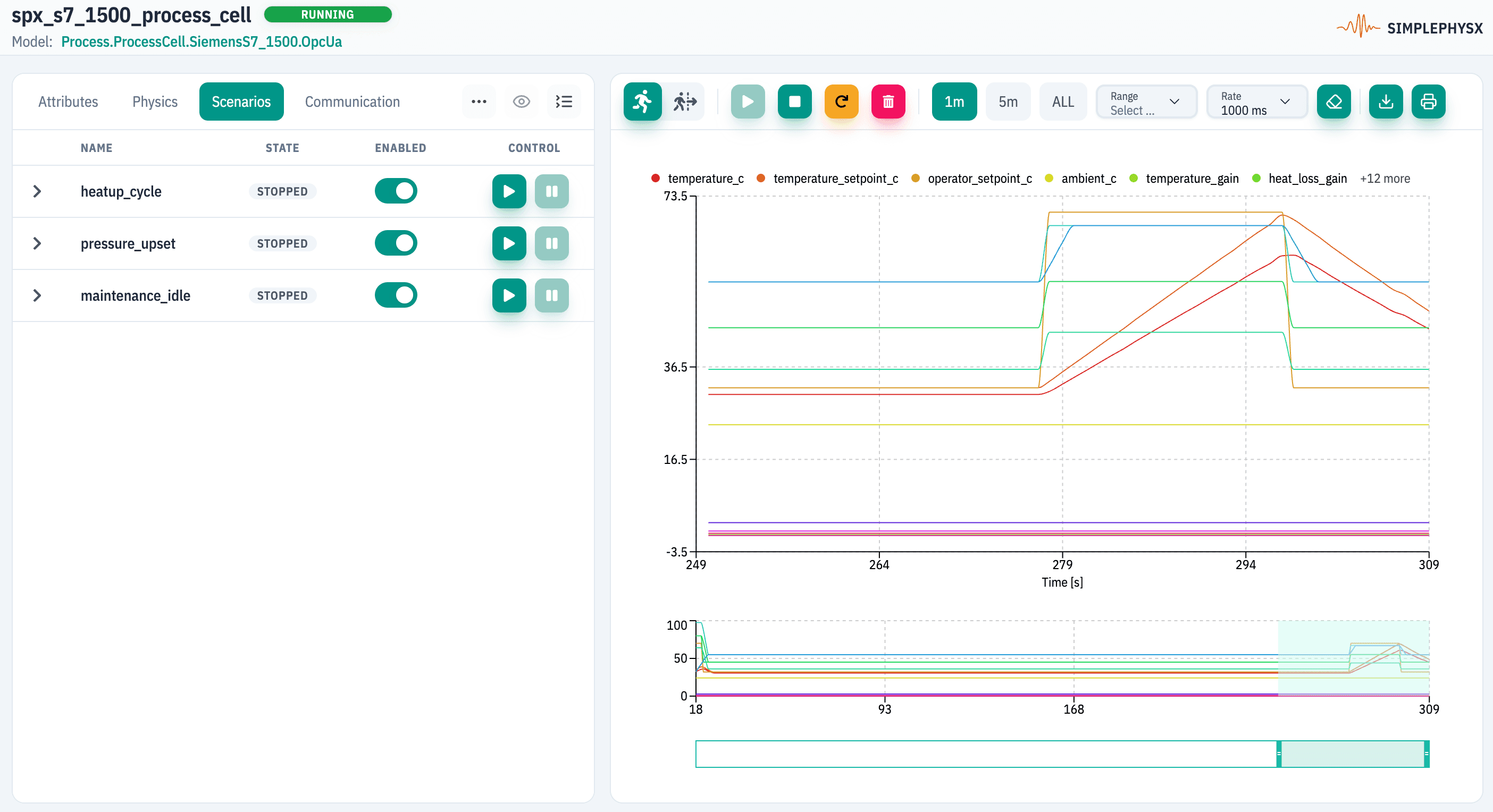
Runtime dashboard with active digital twins, live values, and observability.
Inspect endpoints, values, state, and health for each running digital twin in one place.
Recreate timing-sensitive flows and restart from known baselines without rebuilding your whole test environment.
Diagnose faults, drift, and communication behavior from runtime evidence instead of inferring from incomplete stubs.
Protocols
Use the same SPX product to validate MQTT, Modbus TCP, OPC UA, BACnet, KNX, OCPP, SCPI, CoAP, and BLE integrations against controllable twin behavior.

Simulate connected devices, topic flows, and reconnect behavior with live twin state.

Validate nodes, namespaces, subscriptions, and client behavior against live twin state.
Test registers, scaling, timing, reads, writes, and faults against live device behavior.

Test objects, properties, schedules, alarms, and building behavior before commissioning.

Validate group addresses, sensors, actuators, schedules, and automation behavior.
Test charge points, CSMS flows, transactions, meter values, and reconnect behavior.

Validate short-range device links, characteristic updates, and embedded integration behavior.

Test resource trees, constrained devices, observe flows, and LwM2M integration.

Validate instrument commands, measurements, state changes, and firmware test flows.
Developers
Start with a protocol simulator or AI-assisted digital twin, then drive repeatable scenarios, protocol checks, and regression tests from Python, Docker, and CI/CD.
Install SPX
A quick onboarding page for installing SPX, checking requirements, connecting MCP, and running the first example.
Develop SPX Library
Runnable examples, tests, profiles, and implementation patterns for SPX SDK and server workflows.
MCP-ready workflows
Local MCP guidance for agent-assisted model inspection, validation, runtime control, and repository work.
CI/CD-ready workflows
Run scenarios, protocol checks, and regression tests against the same digital twins in repeatable engineering pipelines.
Ready to start
Simulate real communication, design behavior-rich twins with AI, validate the whole system, and automate proven checks before hardware is ready.